

The Ultimate Legionnaires Risk Assessment Template
Legionella isn’t exactly the kind of topic anyone brings up at Friday drinks, yet it always manages to sit quietly in the background of compliance conversations. For commercial surveyors across the UK and Ireland, it’s a risk you’re expected to understand inside out, even when clients don’t fully grasp what’s involved. That’s where having a clear, practical and repeatable Legionnaires’ risk assessment template makes life a whole lot easier.
This guide sets out everything surveyors need. You’ll learn what a strong template includes, the legal responsibilities behind it, how to structure your assessment, and how digital tools like GoReport help you carry out legionella surveys far faster. The goal is simple: help you deliver assessments that are accurate, compliant and easy for clients to understand.
Before we get into the technical bits, here’s a quick contents list.
Contents
-
What a Legionnaires’ Risk Assessment Template Should Deliver
-
Why Surveyors Benefit From a Standardised Template
-
Legal Requirements for Legionella Risk Assessments
-
Key Sections to Include in a Legionnaires Template
-
Example Legionnaires’ Risk Assessment Template Layout
-
Common Legionella Risks in Commercial Buildings
-
How GoReport Helps Streamline Legionella Surveys
-
Using Your Template Effectively On Site
-
Frequently Asked Questions
What a Legionnaires Risk Assessment Template Should Deliver
Let’s be honest: some templates look impressive on paper but fall apart the second you try using them during an actual survey. A real working Legionnaires’ risk assessment template needs to support fast, consistent data capture without drowning the surveyor in filler text.
A strong template should:
- Gather consistent information across multiple sites.
- Make on-site inspections easier, not harder.
- Meet legal requirements across the UK and Ireland.
- Provide a clear framework for risk scoring.
- Translate technical findings into plain language for clients.
The best templates almost feel like they’re anticipating your next step. They help guide your thinking while keeping the structure simple enough to use on a cold Tuesday morning in a plant room.
This guide is here to help you create a template like that.
Why Surveyors Benefit From a Standardised Template
Surveyors spend enough time walking through plant rooms and tracing pipework without having to improvise a new structure for every report. A consistent Legionnaires’ risk assessment template gives you a system to rely on regardless of building type.
A standard template helps you:
- Reduce time spent writing up reports.
- Ensure consistency across every assessment.
- Present findings clearly to dutyholders.
- Avoid missing critical items.
- Speed up follow-up visits and yearly reviews.
It also builds trust. When clients see familiar, structured reporting, they feel more confident in the recommendations. And as you know, nothing complicates a job faster than a confused client.

Legal Requirements for Legionella Risk Assessments
Surveyors aren’t just ticking boxes for the fun of it. Legionella management is a legal requirement. Your Legionnaires’ risk assessment template should reflect the regulations that dutyholders must comply with.
In the UK, the key legislation includes:
- Health and Safety at Work Act 1974
- Control of Substances Hazardous to Health Regulations 2002
- ACoP L8
- HSG274 Parts 1, 2 and 3
In Ireland, refer to:
- Safety, Health and Welfare at Work Act 2005
- HPSC guidelines on Legionella
- Standard industry guidance for building services
Your role as a surveyor is to identify risks and present findings clearly. Dutyholders depend on your assessment to meet their legal responsibilities. A well-structured template keeps things accurate and compliant across every site.
Key Sections to Include in a Legionnaires Template
Below are the essential components that every Legionnaire’s risk assessment template should include. These sections create a clear journey from initial inspection to final recommendations.
1. Property and System Overview
Include details such as:
- Building type and usage
- Occupancy levels
- Hot and cold water system descriptions
- Overview of tanks, calorifiers and distribution routes
This section gives important context for risk scoring.
2. Responsible Persons
Record:
- Dutyholder
- Responsible person for maintenance
- Water hygiene contractors
Doing so helps confirm where accountability lies.
3. Temperature Readings and Compliance Checks
Capture:
- Cold water sentinel outlets
- Hot water sentinels
- Return temperatures
- TMV outlets
- Flow and performance observations
Temperature evidence is one of the strongest indicators of system health.
4. System Assets and Condition Checks
Inspect:
- Tanks and their insulation
- Calorifiers and hot water sources
- Pipework and distribution routes
- Dead legs
- Accessibility
- Vents, strainers and protective covers
Make notes on contamination, corrosion or visible issues.
5. Identified Legionella Risks
Each risk should have:
- Description
- Location
- Why it’s a problem
- Level of severity
- Recommended action
This is the part clients read most closely.
6. Control Measures and Recommendations
Summarise actions such as:
- Temperature corrections
- Flushing regimes
- Cleaning and disinfection
- Removal of dead legs
- Insulation repairs
- Servicing of TMVs
Clear guidance helps clients take quick action.
7. Overall Risk Rating
Provide an overall site risk rating using a clear scale.
8. Photographs and Evidence
Create space for:
- Photos
- Captions
- Locations
Photographs help explain findings better than text alone.

Example Legionnaires Risk Assessment Template Structure
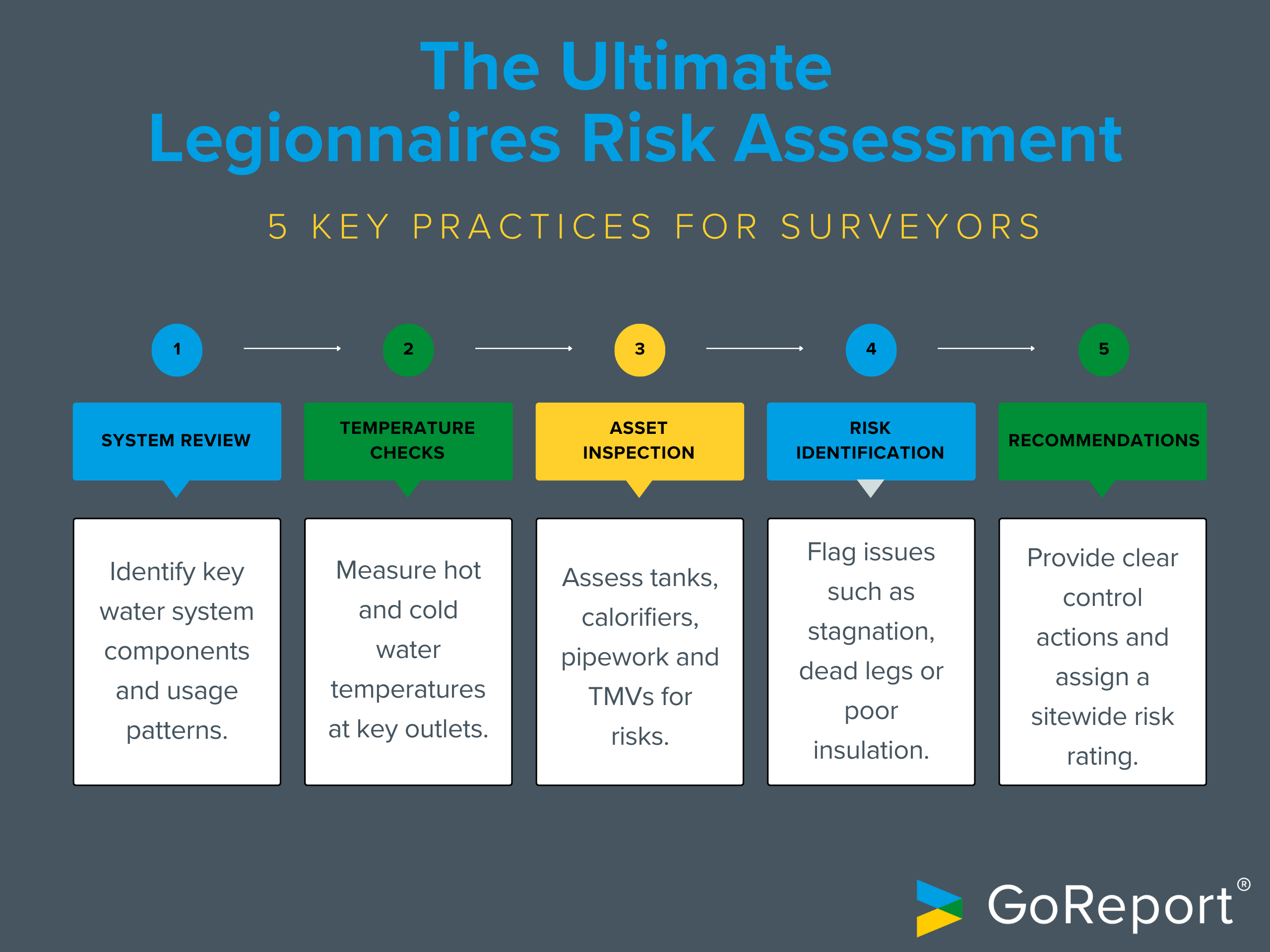
Here is a structured Legionnaires’ risk assessment template layout you can use directly or adapt for your survey reports.
SECTION 1: Site Details
- Building name
- Address
- Survey date
- Surveyor
- Client representative
SECTION 2: System Overview
- System type
- Storage temperature sources
- Cold water supply
- Hot water generation
- Distribution routes
- Areas supplied
SECTION 3: Occupancy Profile
- Number of occupants
- Occupant type
- Vulnerable users
- Typical daily water usage
SECTION 4: Temperature Readings
- Cold water temperatures
- Hot water temperatures
- TMV checks
- Circulating temperatures
- Comments on compliance
SECTION 5: Asset Inspection
Include notes on:
- Tanks
- Calorifiers
- Pipework
- TMVs
- Outlets
- Accessible voids
SECTION 6: Identified Risks
Include:
- Issue
- Location
- Severity
- Control measure
- Timescale for resolution
SECTION 7: Recommended Control Actions
Provide a concise, prioritised list.
SECTION 8: Photographs
Include all relevant imagery, clearly labelled.
SECTION 9: Summary and Sitewide Risk Rating
A brief wrap-up for the client.
Common Legionella Risks in Commercial Building
While each building is different, most surveyors see the same issues crop up again and again. These common risks should be baked into your Legionnaires’ risk assessment template.
- Cold water above 20°C
- Hot water below 50°C at outlets
- Lukewarm storage temperatures
- Stagnant sections of pipework
- Dead legs left after refurbishments
- Poor insulation
- Debris or scale in tanks
- TMVs in poor condition
- Low flow rates causing stagnation
These risks might seem small, but they create the perfect conditions for legionella growth. When your template accounts for them, your assessments stay accurate across every building type.
How GoReport Helps Streamline Legionella Surveys
This is where reporting becomes much easier. Instead of juggling paper templates, spreadsheets and folders of photos, many surveyors are switching to digital Legionnaires’ risk assessment templates through GoReport.
GoReport helps you:
- Capture temperatures and readings in structured fields
- Add notes quickly on a mobile device
- Insert photos directly into the template
- Cut repeated data entry
- Maintain consistent layouts
- Produce professional reports instantly
- Reduce admin time after site visits
Digital forms give surveyors a smoother workflow and take a lot of the pressure off during busy periods.

Using Your Template Effectively On Site
Having the template is one thing. Knowing how to use it well during a survey is another. Here are practical tips surveyors rely on.
Start With the System Layout
A quick photo of schematics or O&M manuals saves time later.
Capture Temperatures First
You get more accurate readings before the water system warms through the day.
Photograph Before Writing
Photographs support your reasoning and reduce the need to rewrite descriptions.
Log Issues As You Go
Don’t leave risk identification until the end.
Use the Template as a Prompt
A good template keeps you consistent without slowing you down.
Once this becomes routine, assessments get noticeably faster and easier.
A reliable Legionnaires’ risk assessment template helps you stay consistent, reduce risk and deliver clear guidance to every client. When paired with digital data capture, you can speed up on-site work and produce polished reports without drowning in admin.
If you want a template built into a smart digital format that captures data on site, automates your report and supports compliance across every job, you can book a free demo with GoReport.
FAQ
What is a Legionnaires’ risk assessment template?
A Legionnaires’ risk assessment template is a structured document that surveyors use to record details about a building’s hot and cold water systems, identify potential Legionella risks and provide recommended control measures. It ensures every assessment follows a consistent format and meets legal guidance.
Is a Legionella risk assessment compulsory?
Yes. A Legionella risk assessment is legally required for any commercial building, rental property or workplace with a water system. Dutyholders must assess and manage Legionella risks to comply with health and safety law in the UK and Ireland.
How long does a Legionella risk assessment take?
The time varies based on the size and complexity of the building. A small commercial site may take one to two hours, while larger premises with multiple outlets, tanks or plant rooms can take several hours. Reporting time is shorter when using digital tools such as GoReport.
How much should a Legionella risk assessment cost?
Costs usually range from £150 to £350 for smaller buildings. Larger or high-risk sites may cost £500 to £1,500 or more depending on the number of assets, water system complexity and reporting requirements. Prices vary by region and contractor.
What are the symptoms of Legionella in drinking water?
Legionella does not affect the taste, smell or look of drinking water, so you won’t notice anything unusual. Symptoms appear in people, not the water. They include fever, cough, chills, shortness of breath and pneumonia. This is why routine assessments are essential.
Is Legionella common in tap water?
Low levels can occur naturally in many water systems, including mains water, but they only become dangerous when the system allows bacteria to multiply. Stagnation, lukewarm temperatures and poor maintenance increase the risk. Proper monitoring keeps tap water safe.
Who needs a Legionnaires’ risk assessment?
Any organisation responsible for a building with a hot and cold water system must carry out a Legionella risk assessment. This includes commercial offices, healthcare facilities, industrial buildings, hotels, leisure centres and rented residential properties.
How often should legionella risk assessments be reviewed?
Most buildings require a review every two years. Systems with high-risk occupants, complex water systems or evidence of non-compliance may need more frequent reviews or ongoing monitoring.
Do all commercial buildings need a legionella risk assessment?
Yes. Any commercial property with running water, stored water or systems that create spray or aerosols must have a Legionella risk assessment in place.
Can GoReport be used to complete legionella assessments?
Yes. GoReport provides structured digital Legionnaires’ risk assessment templates that surveyors can complete on site. The system captures measurements, photos and findings and automatically generates a professional report for clients.




Getting started with GoReport
Whether you’re a sole trader, a multi-surveyor practice, or part of a global organisation, we’re ready and waiting to start your digital journey.